Alpine Ash forest, near Healsville.
And a rather fine blue sky!
You can find more skies at Sky Watch Friday.
Friday, 30 May 2014
Wednesday, 28 May 2014
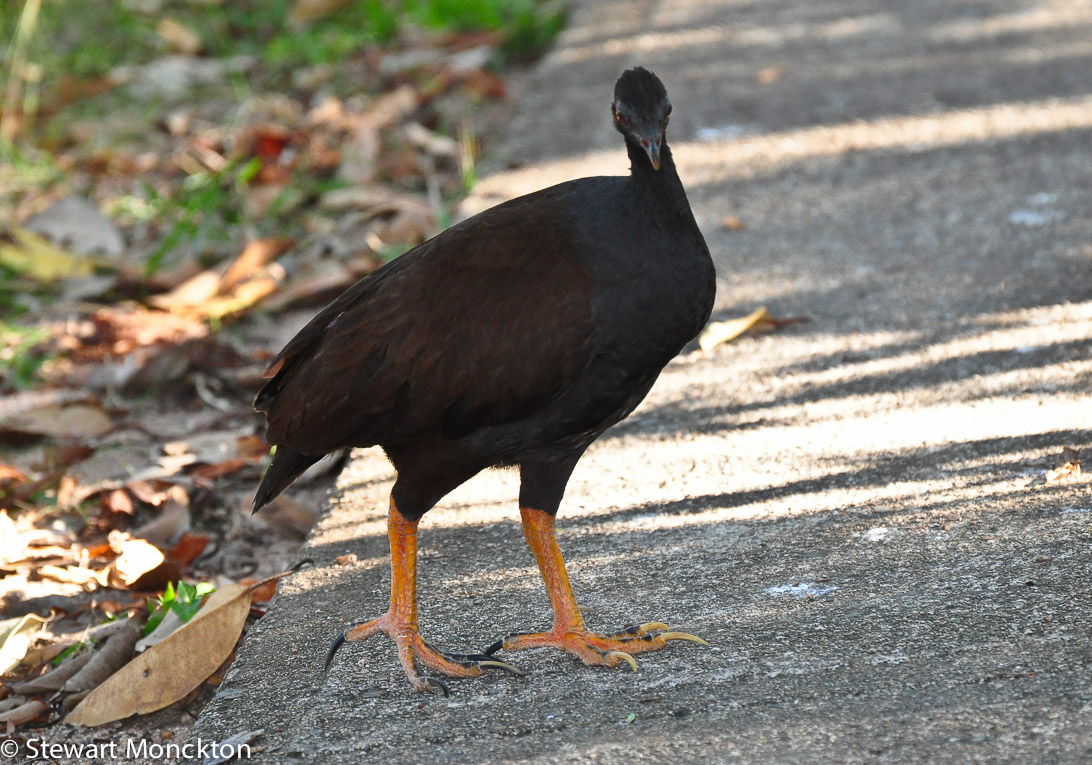
Wild Bird Wednesday 98 - Orange-footed Scrubfowl
Many people have commented on the colourful nature of Australian birds - and in a number of cases I have to say they were correct. I have to say that it does make me smile when such comments come from bloggers who post pictures of Northern Cardinals and Humming birds!
So, just to prove that not all Australian birds are incandescently bright, I give you the Orange-Footed Scrubfowl. It's one of the few birds I know of that have more brightly coloured feet than feathers!
This bird was feeding in a garden on Magnetic Island, Queensland, when I saw it. The adult normally have a small, stiff, crest. But even that is missing on this individual - I suspect it may be a well grown juvenile. The scientific name for this species - Megapodius reinwardt - makes reference to its large feet. ("Mega" as in large, and "pod" as in foot).
For all of this birds lack of colour, it still does have a trick or two up its feathered sleeve to keep us interested. This bird belongs to a group called the "Mound Builders" - and that is exactly what they do. They scrape together large piles of leaf litter to form natural compost piles, and into those piles they place their eggs. The heat released as decomposition occurs incubates the eggs. Some Mound Builders add or remove material during the incubation period to regulate the temperature of the eggs, but the Orange-Footed Scrubfowl seems to rely on getting the eggs buried in an appropriate location in the first place. Some of the mounds they build are huge - maybe even a big as 150m in circumference!
Just to finish off the story, this bird roosts in trees, which seem a good idea for a roast sized bird!
Now it's over to you - and I'm sure your birds will have brighter colours, but maybe smaller feet!
Don't forget to visit as many other WBWers are you can, and (as ever) feel free to invite along new bloggers.
So, just to prove that not all Australian birds are incandescently bright, I give you the Orange-Footed Scrubfowl. It's one of the few birds I know of that have more brightly coloured feet than feathers!
This bird was feeding in a garden on Magnetic Island, Queensland, when I saw it. The adult normally have a small, stiff, crest. But even that is missing on this individual - I suspect it may be a well grown juvenile. The scientific name for this species - Megapodius reinwardt - makes reference to its large feet. ("Mega" as in large, and "pod" as in foot).
For all of this birds lack of colour, it still does have a trick or two up its feathered sleeve to keep us interested. This bird belongs to a group called the "Mound Builders" - and that is exactly what they do. They scrape together large piles of leaf litter to form natural compost piles, and into those piles they place their eggs. The heat released as decomposition occurs incubates the eggs. Some Mound Builders add or remove material during the incubation period to regulate the temperature of the eggs, but the Orange-Footed Scrubfowl seems to rely on getting the eggs buried in an appropriate location in the first place. Some of the mounds they build are huge - maybe even a big as 150m in circumference!
Just to finish off the story, this bird roosts in trees, which seem a good idea for a roast sized bird!
Now it's over to you - and I'm sure your birds will have brighter colours, but maybe smaller feet!
Don't forget to visit as many other WBWers are you can, and (as ever) feel free to invite along new bloggers.
Tuesday, 27 May 2014
Mont Albert Railway Lines
Another Saturday walk - more pictures.
I liked the perspective in these shots, and thought black and white would be good for industrial landscapes! SM
You can find more shots from around the world at Our World Tuesday.
I liked the perspective in these shots, and thought black and white would be good for industrial landscapes! SM
You can find more shots from around the world at Our World Tuesday.
Monday, 26 May 2014
Post Boxes.
No junk mail? Well maybe not.
A face? Well possibly.
A face, with a stick in one eye? Possible again!
You can find more macro shots at Macro Monday 2 and I Heart Macro. SM
A face? Well possibly.
A face, with a stick in one eye? Possible again!
You can find more macro shots at Macro Monday 2 and I Heart Macro. SM
Friday, 23 May 2014
A Saturday Walk - A ginko sky
The yellow leaves of a Ginko tree against the pale morning sky caught my eye.
You can find more skis at Sky Watch Friday.
Wednesday, 21 May 2014
Wild Bird Wednesday 97 - Red-Capped Plover
The Red-Capped plover is another bird I associate with sandy beaches - although it does not seem to have the appetite for the same rough ocean swells as the Hooded plover from last week.
Having said this, these images were taken on the edge of a partially tidal lake - not really an estuary, but not far enough up into the freshwater to be a river - a real half way house.
For once, the scientific name of this bird makes obvious sense - Charadrius ruficapillus - even if "ruficapillus" actually does mean "red-haired". (Given the sort of hair my family have, this bird has just moved up a few places in my favourites list!)
This bird is in the same genus Ringed and Little-Ringed Plovers which are more widespread around the world.
At 14-16cm long this is not a large bird - but its fast running habits make it rather conspicuous at times. As you can see from the foot marks in the sand around this birds feet, there has been a lot of running in this area.
This chap is a male - the dark line at the "shoulder" and the clear black lines around the "fox red" cap separate him from the female.
Now its over to you - click on the link button below and off you go. Get your "editing heads" on as I think I'm going to use WBW 100 (in 3 weeks) as a chance for people to repost their favourite shot that they have shared through the first 100 WBWs. Cheers SM
Having said this, these images were taken on the edge of a partially tidal lake - not really an estuary, but not far enough up into the freshwater to be a river - a real half way house.
For once, the scientific name of this bird makes obvious sense - Charadrius ruficapillus - even if "ruficapillus" actually does mean "red-haired". (Given the sort of hair my family have, this bird has just moved up a few places in my favourites list!)
This bird is in the same genus Ringed and Little-Ringed Plovers which are more widespread around the world.
At 14-16cm long this is not a large bird - but its fast running habits make it rather conspicuous at times. As you can see from the foot marks in the sand around this birds feet, there has been a lot of running in this area.
This chap is a male - the dark line at the "shoulder" and the clear black lines around the "fox red" cap separate him from the female.
Now its over to you - click on the link button below and off you go. Get your "editing heads" on as I think I'm going to use WBW 100 (in 3 weeks) as a chance for people to repost their favourite shot that they have shared through the first 100 WBWs. Cheers SM
Subscribe to:
Posts (Atom)