Tuesday, 5 November 2019

A Whale Tale

Last weekend I went on a whale watching tour that started from Port Welshpool and travelled down the east coast of Wilsons Promontory.  I had never seen that part of the Prom from the sea before, and I like whales - so it was a good. mix.

The weather on the day was really variable - heavy rain followed by bright sun.  We saw at least 7 or 8, and maybe more, whales.  However, they all remained rather distant from the boat and were just in travelling, rather than playing mode!  Shame really, but it was great to get out into the (very) fresh air after too much time in the office over the last few weeks.

As you can (just) see in the first picture there were two whales in sight at this time.  You will need to make the picture large to see the second, distant flipper.  As far as I know, all of these whales are Humpback Whales.


You can find more shots from around the world at Our World Tuesday.  SM

Tuesday, 29 October 2019

Wild Bird Wednesday 380 - White-Plumed Honeyeater

The White-Plumed Honeyeater (Lichenostomus penicillatus) is a widespread and common Australian endemic.  It is also I bird that seems to have escaped my photographic pursuits until I went to central Australia a while ago.

Like many of my recent WBW posts this bird was living (wild) in the Desert Park in Alice Springs.  The White-Plumed Honeyeater has a wingspan of about 90mm and at its heaviest reaches about 24 grams.  So, its not really a big bird!

I really like the colour contrast in these pictures between the bird and the plant on which it is perched.


As ever, you can join in with WBW by clicking on the link below - and also as ever, please feel free to share the love for WBW with other bloggers!   SM


You are invited to the Inlinkz link party!
Click here to enter

Tuesday, 22 October 2019

Wild Bird Wednesday 379 - Australian Ringneck - aka Port Lincoln Parrot

This week's WBW is brought to you by the highly variable Australian Ringneck Parrot (Barnardius zonarius) which occurs in a number of sub-species.

These birds are examples of the subspecies Barnardius zonarius zonarius (dont you just love taxonomy!) - which is also know as the Port Lincoln Parrot.  This is the most widespread of the sub-species of this parrot.

These birds were photographed in the Desert Park in Alice Springs.  They are not an uncommon bird in Alice.  In fact, they can be found on the main street of the town, where they have become used to stealing packets of sugar from cafe tables!

These birds were a little more wild than that.


As ever, you can join in with WBW by clicking on the link below - and also as ever, please feel free to share the love for WBW with other bloggers!  

I have not been able to reply to comments from last week yet - after 378 weeks in a row I hope you can forgive this tardiness!

Cheers. SM


You are invited to the Inlinkz link party!
Click here to enter

Wednesday, 16 October 2019

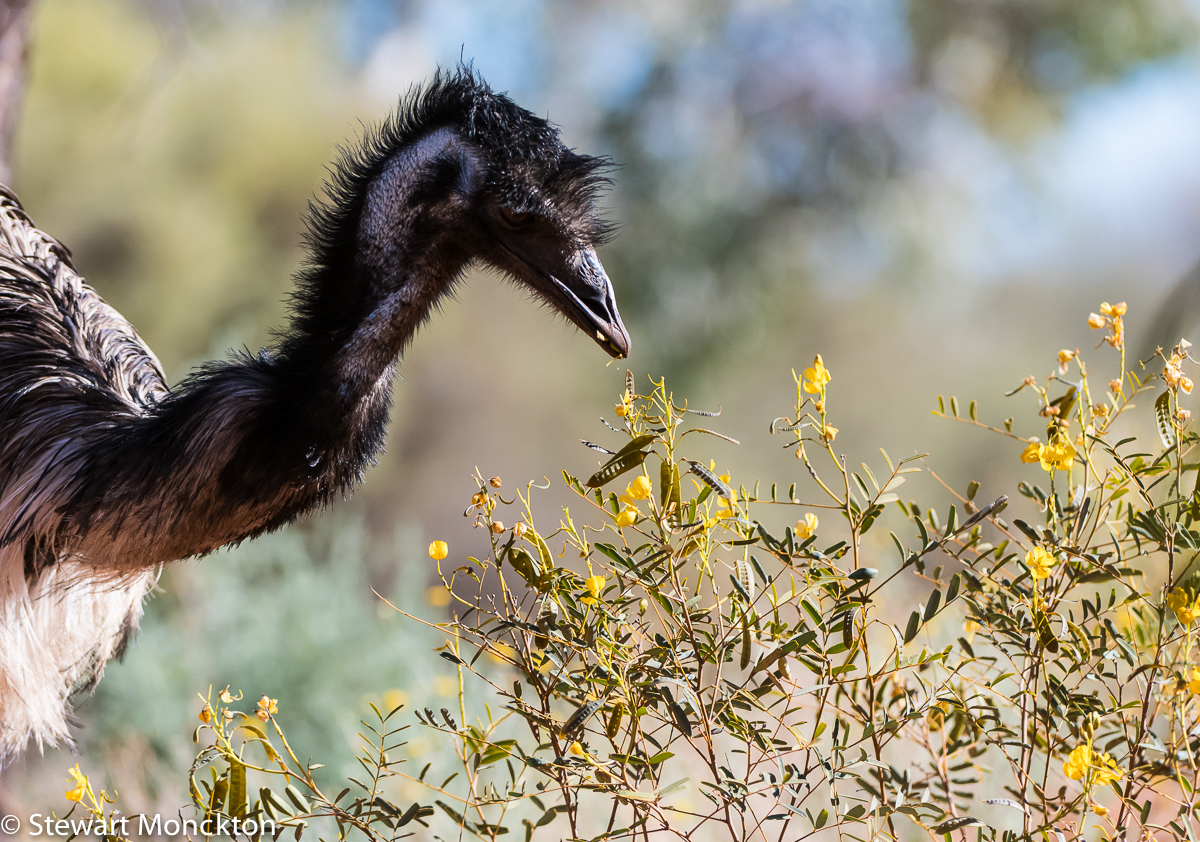
Wild Bird Wednesday 378 - Emu

This week's WBW is brought to you by the number 378 and the letter Emu!

It's been really busy here: work, family birthdays, too much cake (if such a thing is possible) and other time consuming events!

So, for this week, here is an Emu (Dromaius novaehollandiae) having a breakfast of nice yellow flowers in the Alice Springs Desert Park.


As ever, you can join in with WBW by clicking on the link below - and also as ever, please feel free to share the love for WBW with other bloggers!  Cheers. SM


You are invited to the Inlinkz link party!

Click here to enter

Tuesday, 15 October 2019

Barrow Creek

Barrow Creek is almost 300km north of Alice Springs and has a current population of 11.

This ute was a bit of a local landmark.  When things go wrong here, they have a tendency to stay wrong.  The owner of the fuel station / shop / pub that makes up most of Barrow Creek told us he spends about $180 a day on diesel to run the electrical generators.

Its a strange kind of place.


As you may be able to tell from these pictures - it was hot here too!

You can find more shots from around the world at Our World Tuesday.  SM


Wednesday, 9 October 2019

Wild Bird Wednesday 377 - Western Bowerbird

The Western Bowerbird (Chlamydera guttata) is endemic to Australia, meaning it's not found in any other country.

This species is found in Central Australia (where I photographed it) and also in parts of Western Australia.  Interestingly there is a gap between these two areas, where as far as we know, the species is not known.  If you have much of a grasp of the geography of Australia, you may understand that the space between these two areas where the bird is found is pretty much the middle of nowhere.  So, this distribution could be as much a case of where people have looked, rather than where the bird lives.   Maybe a survey of that area could be a project for when I retire!

The bird itself has a wing span of about 140mm and is built much like a slight muscular thrush.  As you can see in a couple of the pictures, this species has a pink 'erectile nuchal crest' on its neck.  (Nechal means 'neck' - I had to look that up!)


You can see a black irrigation pipe in the background of the last picture.  These birds (and I think these are three different birds)  were all photographed at the Alice Springs Desert Park, but they are all wild bird that take advantage of the watering and abundance of plants.

As ever, you can join in with WBW by clicking on the link below - and also as ever, please feel free to share the love for WBW with other bloggers!  Cheers. SM


You are invited to the Inlinkz link party!
Click here to enter