Monday, 10 March 2014

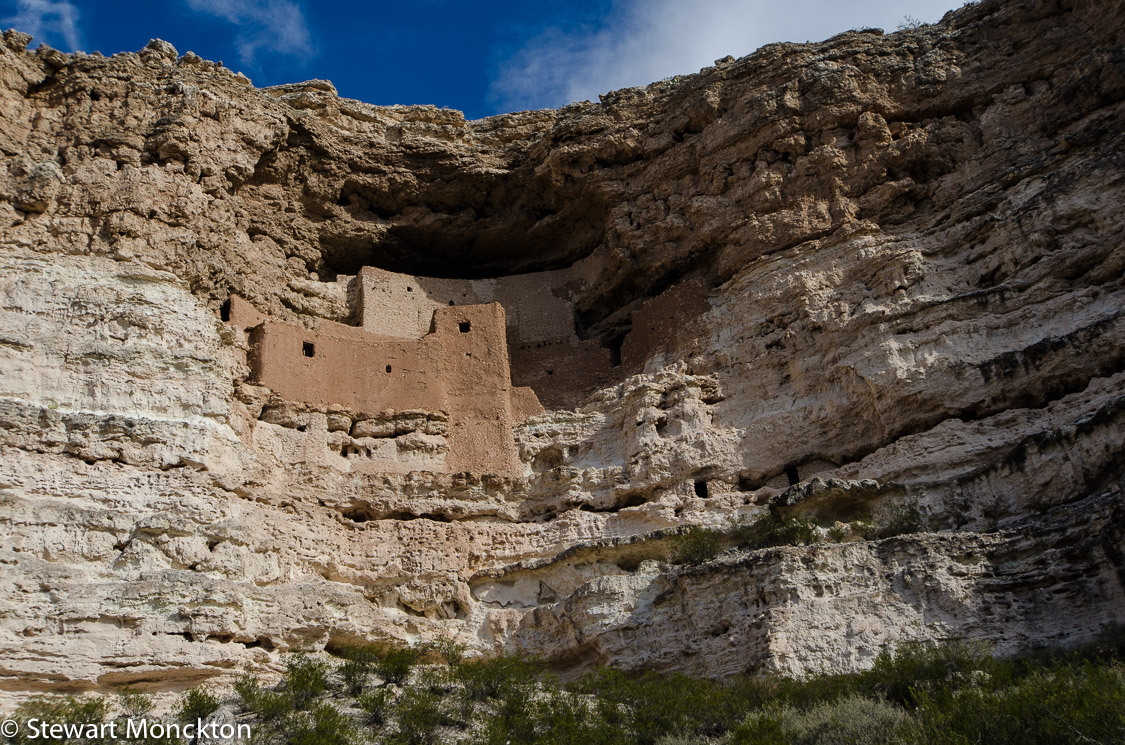
Montezuma Castle - Arizona

I left Australia at 11am and 20 or so hours later I had checked in to my hotel at 1pm on the same day.

Strange.

Sleep proved far more difficult that I had hoped for.

The alarm sounded at what it claimed was 6am on the next day.  I did not really believe it.

Coffee called.

Still battling the effect of a day that lasted almost twice as long as normal, and gripped by jet lag I waited for a small tour bus outside of my hotel in Scottsdale, Arizona.

The first part of the journey is all a bit hazy really: cactus, sand, the sing song accent of the guide who repeated the himself at the end of most sentences.  "There are 41 types of cactus in Arizona.  41!"

We pull off route 17 for our first stop.  I may be early morning.  It could be midnight - I'm just not sure.

We pull into the car park of a National Monument called Montezuma Castle - which is not really associated with the Aztec king Montezuma nor a castle.

The builders of this cliff dwelling were Sinagua farmers, who worked the fertile river terraces below the cliff and traded the salt that they gathered locally.  Apparently, the building once contained 45 rooms and rose to five stories high.


Looking at this building it was remarkable to consider that this civilisation basically disappeared from this area in the 1400's.  We don't really know why.  But it's clear that this was a sophisticated culture, so the reason for leaving must have been pretty significant.

The other thing I found interesting about this site was it name - while the people who built the building have long since left, we do know that its in nothing to do with Montezuma and it was not a castle.  In Australia, many important landmarks are now routinely called by the names given to them by the local Aboriginal people.  This seems an appropriate thing to do - and in some small way gives credit and recognition to the people who came before us.  I can't help but think it would be appropriate here too.

You can find more shots from around the world at Our World Tuesday.

Sunday, 9 March 2014

Arizona Sand

As some of you may be aware I was away from my home base for much of the last two weeks - a work trip took me to Scottsdale in Arizona.  And as is my way, I managed to organise a couple of spare days to exploration while I was there.

As a result the next few posts will be based around these few spare days, rather than my normal Australian peregrinations.

At the end of a long day of travel - which took in my first views of the Grand Canyon - we stopped for yet more coffee at Cameron, which is a small settlement on the Navajo Indian Nation, near the Little Colorado River.

Just outside of Cameron we stopped to look at a rather good sky - but I was (temporarily) distracted by the sand under my feet. The low evening sun was picking up the hundreds of rounded crystals half buried, half exposed, by the sand.  They were rounded - as where most of the other larger stones - which means (I think) that while I was stood in the middle of a desert I was standing on a river made landscape.  Given that I had been looking at the Grand Canyon for much of the day, this was hardly a surprise I suppose - but it struck me as remarkable.

Where ever you look, if you look hard enough, you can find surprises.


Once I mentioned the stones and crystals to the other people on the bus, many were uprooted and collected.  I think this is a little sad.  I rather wished I had not said anything about them. The crystals and stones will probably end up, pushed to the back of cupboards in frayed plastic bags, dull and forgotten.  I just wish people could leave things alone - memories are as wonderful (if not more so) than possessions.

Strange thoughts from a patch of water worn stones.

You can find more close up shots at Macro Monday 2 and I Heart Macro.

Friday, 7 March 2014

Evening Sky

Last of the run of busy posts - I hope!

This picture was taken as the last sun of the day caught the pier at Queenscliff.  I really like the way the buildings on the pier seem to glow.


You can find more sky shots at Sky Watch Friday.

I suspect that I will be a very long way behind with replies by this stage - so I'm apologising in advance!  SM

Wednesday, 5 March 2014

Wild Bird Wednesday 86 - Curlew Sandpiper

Shallow wetlands are often a real draw for waders and other wildfowl.  Exposed mud is even better.  And a combination of both is paradise.

An area of old shell diggings at Point Lonsdale - called Lake Victoria - is a good example of this combination.  Lake Victoria is a shallow saline lake that in part was formed by the digging a deposit of  shells, local known as shell grit.

I was wandering though the area a while ago and found it busy with waders.  Many were rather long way away and as I can either carry a long lens or a telescope, but not both, I could not get brilliant views of the roosting birds.

This is one of the better shots of the largest roost. (You need to click on the image for the best view)


The flock of birds contains Curlew Sandpipers, Red Necked Stints and Sharp-tailed Sandpipers.  Behind the main flock are some Chestnut teal.  The large, pale wader in front of the flock is a Common Greenshank (well, I was watching Greenshank a few minutes later, and only found this bird in the image when I looked at it at home!)

I waited a while and managed to get some images of birds that were rather closer - the best of these were of Curlew Sandpipers - Calidris ferruginea. 

The Curlew Sandpiper breeds in North East Siberia and spends its non-breeding time in Australia (and many other southern countries as well).  When it is in breeding plumage the front of the bird is a wonderful red colour.  This is where the ferruginea part of its name comes from - remember that Iron is red, and Fe is the chemical symbol for Iron.


If you ever get a chance to visit The Bellarine peninsula I would recommend a walk around this lake.

Now its your turn - and please don't forget to limit the text in the widget to your name and a location.


Tuesday, 4 March 2014

Mud Islands? Maybe Not 2

Just a brief post!

This may be one of the stranger things I have found on a beach!

I have have to say that even Mud Islands has a better ring to it than "Lost Green Rubber Ring Island" - there was a football a little way down the beach, but it was collected before I got a shot.

The Ring was collected, deflated and taken home!


You can find more shots from around the world at Our World Tuesday.

Cheers - SM

Monday, 3 March 2014

Mud Islands? Maybe not!

As regular readers will be aware I rather like a trip out to Mud Islands, which are just off the coast of Queenscliff in Port Phillip Bay.  Melbourne sits at the head of the Bay, and the other sides are flanked by long peninsulas - The Bellarine Peninsula is my favourite.

Even from my first footsteps on Mud Islands I thought that the name was a bit off - and this picture shows why - in places it should be called Shell Islands!


You can find more macro type shots at Macro Monday 2 and I Heart Macro.

Cheers SM