Busy week back at work - lots of catching up to do.
Rather like this image of pelicans departing into the distance. Could not believe it when they organised themselves nicely in the frame.
Click went the shutter.
This was another shot I took while on a trip to Mud Islands, just off the coast from Queenscliff.
You can find more shots of the sky at Sky Watch Friday.
Friday, 31 January 2014
Wednesday, 29 January 2014
Wild Bird Wednesday 81 - Crested Tern
The Crested Tern is a little more cooperative than many birds, often allowing people to get reasonably close to them before they take flight. These birds were all part of a breeding colony on Mud Islands in Port Phillip Bay. As you will see, most of the chicks were well grown, although some had not yet taken to the air.
This bird goes under the scientific name of Thalasseus bergii - which means Bergius' Fisherman. The fisherman in obvious, and Bergius is the name of the "short lived" German collector who collected the type specimen in souther Africa.
In some books this bird may still be called Sterna bergii - which means Bergius' Tern. Recent studies of the DNA found within the mitochondria of this birds cells resulted in the bird being moved from one genus to another to which it was more closely related. This shows a nice little rule of taxonomy, where the second part of the name follows the bird about, even if the first part changes.
These birds are about 44 - 48 cm long, with a wing span close to 1m. Like most terns they are a delight to watch in their grey, white and black washes.
I think this is my favourite image of the many I took. As the bird is banded there is a remote possibility that I had this bird in the hand as a chick. Apart from the bird, I like the puff of sand caused by its feet as it pushes in the air.
![]() |
| Adult, starting to move out of full breeding plumage |
![]() |
| Adult in display posture |
![]() |
| Well grown chick begging for food. |
![]() |
| Well grown chick |
![]() |
| Creche of well grown chicks |
Now it's your tern (!) to add a link. Feel free to spread WBW through what ever networks you have - the more links the merrier.
Monday, 27 January 2014
Kinglake
Today was the last day of my summer holidays - its a public holiday for Australia Day. The 26th is the actual day, but because that was a sunday, we get monday off. Back to the desk tomorrow!
Just a short walk through some forest that was badly burnt in the Black Saturday bush fires of 2009.
There are many signs of regeneration in the forest - I hope the people of the area are doing as well.
In this picture you can see that some of the mature trees survived the fire, but many are now just dead stags heads. These will become important wild life sites over time. You can also see the huge numbers of young trees in the fore ground - these forests have evolved with fire, but it remains questionable that they will be able to survive the increased fire frequencies that come with human activity and / or climate change.
Its still very dry here, and the next few days are back into the extreme heat level. This whole area could burn again, which is not a happy thought.
As we were driving home I noticed this paddock dotted with hay bales - I rather liked the look of them, so here are two images.
Just a short walk through some forest that was badly burnt in the Black Saturday bush fires of 2009.
There are many signs of regeneration in the forest - I hope the people of the area are doing as well.
In this picture you can see that some of the mature trees survived the fire, but many are now just dead stags heads. These will become important wild life sites over time. You can also see the huge numbers of young trees in the fore ground - these forests have evolved with fire, but it remains questionable that they will be able to survive the increased fire frequencies that come with human activity and / or climate change.
Its still very dry here, and the next few days are back into the extreme heat level. This whole area could burn again, which is not a happy thought.
As we were driving home I noticed this paddock dotted with hay bales - I rather liked the look of them, so here are two images.
Both of these landscape shots look much better bigger - and you can see bigger versions if you click on the image.
You can find more pictures from around the world at Our World Tuesday. SM
Sunday, 26 January 2014
Queenscliff fair
One of the many ways you notice that your kids are growing up is that the rides they want to go on at fairs change. Spinning tea cups are abandoned for bouncy castles, bouncy castles for roller coasters and so on - although I suspect that H may never really give up roller coasters!
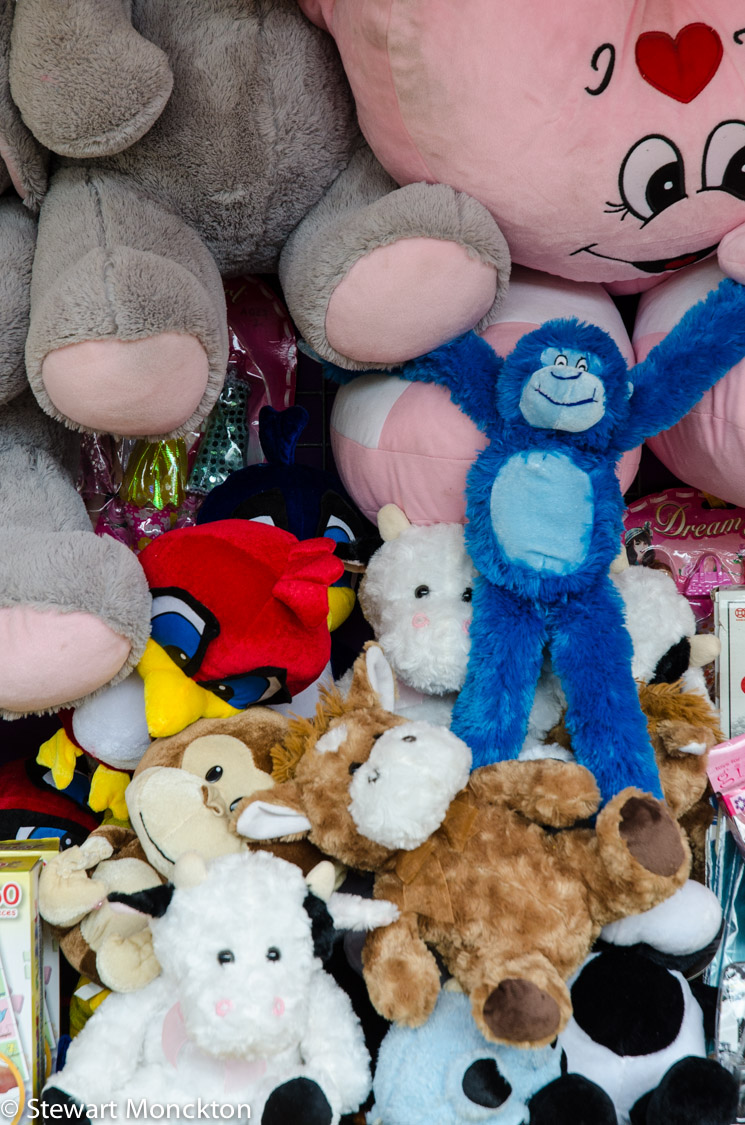
The stalls around the edges of the rides offer cheap tat as prizes and still tilt the odds in the favour of the stall holders. A few years ago the prospect of winning a water pistol with a life span of less than 12 minutes and a cuddly toy, stuffed with some form of industrial waste seemed attractive to my kids - but not so much now.
Although they did seem attractive to me.
I can see why clowns weird out some people - the open face of this one reminds on the open mouthed scream that were used by the "pod people" in the Invasion of the Body Snatchers!
And some of the soft toys are just a little to strange to become favourites!
The stalls around the edges of the rides offer cheap tat as prizes and still tilt the odds in the favour of the stall holders. A few years ago the prospect of winning a water pistol with a life span of less than 12 minutes and a cuddly toy, stuffed with some form of industrial waste seemed attractive to my kids - but not so much now.
Although they did seem attractive to me.
I can see why clowns weird out some people - the open face of this one reminds on the open mouthed scream that were used by the "pod people" in the Invasion of the Body Snatchers!
And some of the soft toys are just a little to strange to become favourites!
You can find more macro shots at Macro Monday2 and I Heart Macro.
Friday, 24 January 2014
Sky from beneath the sea.
I may not have gone unnoticed that we have been spending a few days down at the beach - thankfully we were here during our recent very hot spell, so we spent a lot of time in the sea at the beginning and ending of each day. During the middle bits of the days it was too hot and the spectre of sunburn and its long term health impacts drove us back to shelter.
Once the kids had (briefly) exhausted themselves I would do a bit of snorkelling. I sorted out the "sun burn on the head" issue by using a very thin hood - normally warm under a wet suit in very cold water. It may look a bit over the top - but it seems to work well!
One of the things I like about snorkelling is the ability to be in that transition zone between water and air - and in this zone the light is refracted and reflected in many different ways.
These images were taken with a little waterproof point and shot, held out in front of me and angled a little up at the sky. I rather like the results.
Once the kids had (briefly) exhausted themselves I would do a bit of snorkelling. I sorted out the "sun burn on the head" issue by using a very thin hood - normally warm under a wet suit in very cold water. It may look a bit over the top - but it seems to work well!
One of the things I like about snorkelling is the ability to be in that transition zone between water and air - and in this zone the light is refracted and reflected in many different ways.
These images were taken with a little waterproof point and shot, held out in front of me and angled a little up at the sky. I rather like the results.
You can find more sky shots (and less terms you last heard in Year 9 Physics!) at Sky Watch Friday.
Wednesday, 22 January 2014
Wild Bird Wednesday 80 - Lewin's Honeyeater.
I have engaged in a little bit of archive mining today - far too many new pictures need to be looked at and tagged. On days such as this, it's good to go back to the past.
This bird is a Lewin's Honeyeater - one of a trio of very similar birds - so I hope I have my ID correct.
These pictures were taken on a trip to the north coast of Australia a year or so ago. Along with parrots, gum trees and kangaroos, Australia is home to a vast number of honeyeaters - birds that have adapted to a wide range of habits, but have retained their basic structure. Such groups of animals always pose identification problems.
This bird is a Lewin's Honeyeater - one of a trio of very similar birds - so I hope I have my ID correct.
These pictures were taken on a trip to the north coast of Australia a year or so ago. Along with parrots, gum trees and kangaroos, Australia is home to a vast number of honeyeaters - birds that have adapted to a wide range of habits, but have retained their basic structure. Such groups of animals always pose identification problems.
I am briefly separated from my library, so I can say no more about this bird - apart from the it also goes by the name of Meliphaga lewinii. Normal service will be restored soon.
So, over to you - click the link and off you go.
Subscribe to:
Posts (Atom)